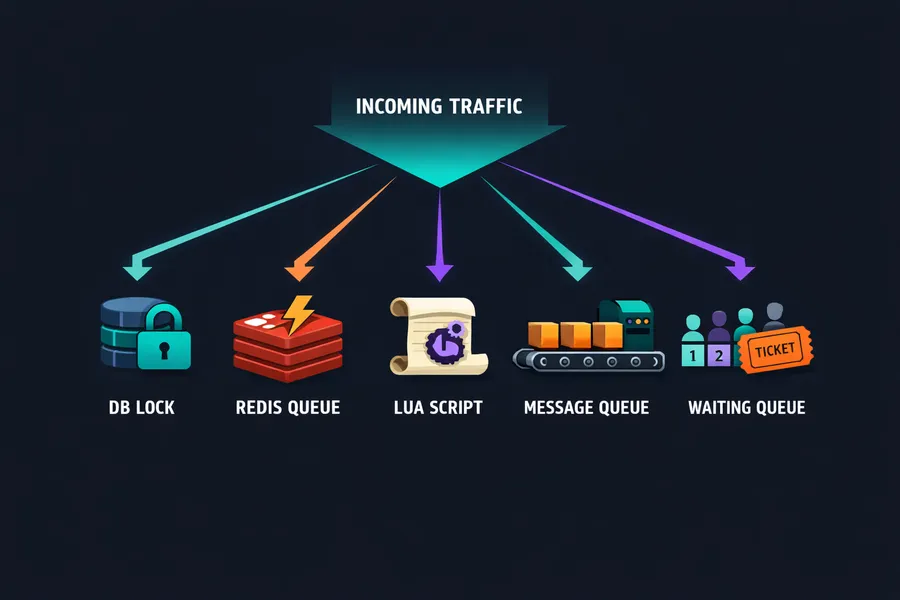
First-Come-First-Served Systems Explained: 6 Implementation Strategies and How to Choose
Introduction
In the previous post, we covered the limits of FOR UPDATE. When 100 users hit simultaneously, 99 wait in line, the connection pool gets exhausted, and deadlock risk follows. DB locks alone can’t handle a high-traffic first-come-first-served system.
This post steps back to see the big picture — what problems does a FCFS system need to solve, what options exist, and when should you use each one?
1. What Is a First-Come-First-Served System?
Concert ticket sales, limited-edition sneaker drops, flash deals — all systems that allocate a fixed quantity to whoever requests first. Sounds simple, but when thousands flood in simultaneously, three core problems emerge.
The 3 Core Problems
| Problem | Description | What happens if unsolved? |
|---|---|---|
| Concurrency control | Thousands try to deduct the same stock at the same instant | 100 items in stock, 150 people purchase successfully (overselling) |
| Accurate stock deduction | Non-atomic deduction operations cause miscounts | Stock goes negative, or two requests read the same value and only one deduction registers |
| Duplicate prevention | Same user submits multiple requests and wins multiple times | One person takes 10 items |
Analogy: A bakery selling 100 limited loaves. Without a line (no concurrency control), people scramble and grab. Without counting (deduction errors), person #101 gets a loaf too. Without checking tickets (no duplicate prevention), one person lines up multiple times.
2. The 6 Implementation Strategies
2.1 DB Pessimistic Lock (SELECT FOR UPDATE)
Core principle: Lock the stock row first, deduct, then release — processing one request at a time.
| Step | Client | Server (DB) | Status |
|---|---|---|---|
| 1 | Purchase request | SELECT stock FOR UPDATE → row locked | 🔒 |
| 2 | Check stock > 0 → UPDATE stock = stock - 1 | ✅ Deducted | |
| 3 | COMMIT → lock released | 🔓 | |
| 4 | Next request | Can now acquire lock → repeat | ⏳ |
| Pros | Cons |
|---|---|
| No additional infrastructure (just the DB) | Concurrent requests are serialized (99 wait) |
| Simple implementation | Deadlock risk |
| Strong data consistency | DB connection pool exhaustion risk |
Best for: Under a few dozen concurrent users, early-stage services without extra infrastructure
2.2 Redis Atomic Operations (DECR)
Core principle: Redis DECR executes atomically on a single thread, so stock deduction is safe without locks.
| Step | Client | Server (Redis → DB) | Status |
|---|---|---|---|
| 1 | Purchase request | DECR stock_key → check result | |
| 2 | Result ≥ 0 → purchase success, save order to DB | ✅ | |
| 3 | Result < 0 → INCR stock_key (rollback) → sold out response | ❌ |
| Pros | Cons |
|---|---|
| Tens of thousands of TPS | Data loss risk on Redis failure |
| Atomic without locks | Need to manage Redis-DB data consistency |
| Relatively simple implementation | Rollback logic needed (when result < 0) |
Best for: Hundreds to thousands of concurrent users, services where fast response matters
2.3 Redis + Lua Script
Core principle: Bundle stock check and deduction into a single Lua script that executes atomically in Redis. Unlike plain DECR, “check → deduct” runs as one unit, eliminating negative stock entirely.
| Step | Client | Server (Redis → DB) | Status |
|---|---|---|---|
| 1 | Purchase request | Lua script execution starts (atomic) | 🔒 |
| 2 | Check stock > 0 + check duplicate + DECR → all at once | ||
| 3 | Result: success → save order to DB, failure → immediate response | ✅ / ❌ |
| Pros | Cons |
|---|---|
| Stock check + deduction + duplicate check in one atomic op | Lua script debugging is difficult |
| Negative stock is impossible | Data loss risk on Redis failure |
| No rollback logic needed (check-then-deduct) | Long scripts can block Redis |
Best for: High traffic + want to handle duplicate prevention at the Redis level
2.4 Message Queue (Kafka / RabbitMQ)
Core principle: Push purchase requests into a queue, and consumers process them one by one in order. The requests themselves are serialized.
| Step | Client | Server (Queue → Consumer → DB) | Status |
|---|---|---|---|
| 1 | Purchase request | Publish message to queue → immediate “accepted” response | 📨 |
| 2 | Consumer processes messages in order | ⏳ | |
| 3 | Check stock → deduct → create order | ✅ / ❌ | |
| 4 | Check result (polling / websocket) | Deliver processing result | 📬 |
| Pros | Cons |
|---|---|
| Handles traffic spikes (acts as a buffer) | Asynchronous response (no immediate result) |
| Server load distribution | High implementation complexity (queue + consumer + result delivery) |
| Scalable by adding consumers | Additional infrastructure required (Kafka / RabbitMQ) |
Best for: Massive traffic, cases where immediate response isn’t critical (coupon issuance, event entries)
2.5 Waiting Queue
Core principle: Place users in a queue with assigned positions, then admit them to the purchase page when their turn comes. The “N people ahead of you” pattern seen on Ticketmaster and similar platforms.
| Step | Client | Server (Redis Sorted Set) | Status |
|---|---|---|---|
| 1 | Connect | ZADD queue timestamp userId → enter queue | 🕐 Waiting |
| 2 | ”342 people ahead” display | ZRANK queue userId → check current position | ⏳ |
| 3 | Turn reached | Remove from queue → allow entry to purchase page | 🎫 Admitted |
| 4 | Proceed to purchase | Stock deduction (Redis or DB) | ✅ / ❌ |
| Pros | Cons |
|---|---|
| Keeps server load constant | User waiting experience (UX cost) |
| Fair ordering guaranteed | High implementation complexity (queue + admission control + expiry) |
| Distributes traffic into two phases | Need to handle abandoned slots |
Best for: Tens of thousands of concurrent users, ticketing/booking systems where fair ordering matters
2.6 Token Issuance
Core principle: Issue entry tokens first, and only token holders can purchase. Traffic is completely separated into “token issuance” and “actual purchase” phases.
| Step | Client | Server | Status |
|---|---|---|---|
| 1 | Request token | Token server: issue tokens up to stock quantity → reject when exceeded | 🎟️ / ❌ |
| 2 | Purchase with token | Purchase server: validate token → deduct stock → create order | ✅ |
| 3 | Mark token as expired/used | 🔒 |
| Pros | Cons |
|---|---|
| Purchase server doesn’t get traffic spikes | Requires separate token server + purchase server |
| Token count = stock count → overselling impossible | Need token expiry/fraud prevention logic |
| Load distribution via server separation | User experience split into 2 steps |
Best for: Limited-edition sales, pre-orders, large-scale systems needing physical traffic separation
3. Side-by-Side Comparison
| Strategy | Throughput (TPS) | Complexity | Extra Infra | Data Consistency | Scale |
|---|---|---|---|---|---|
| DB Pessimistic Lock | Low (tens~hundreds) | ⭐ | None | High | Small |
| Redis DECR | High (tens of thousands) | ⭐⭐ | Redis | Medium | Medium |
| Redis + Lua | High (tens of thousands) | ⭐⭐⭐ | Redis | High | Medium~Large |
| Message Queue | High (scalable) | ⭐⭐⭐⭐ | Kafka/RabbitMQ | High | Large |
| Waiting Queue | High (controllable) | ⭐⭐⭐⭐ | Redis | High | Large |
| Token Issuance | High (distributed) | ⭐⭐⭐⭐ | Token server | High | Large |
Throughput isn’t a simple number comparison. DB locks are low because they process “one at a time, in order.” Redis strategies are high because they’re “atomic without locks.” Message queues and waiting queues are “scalable” because you can add consumers to adjust throughput.
4. How to Choose?
Decision Flow
| Step | Question | Answer → Direction |
|---|---|---|
| 1 | How many concurrent users? | A few dozen → DB pessimistic lock is enough |
| 2 | Can you add infrastructure (Redis)? | No → DB pessimistic lock |
| 3 | Is immediate response required? | Yes → Redis DECR or Redis + Lua |
| 4 | Want duplicate prevention at Redis level? | Yes → Redis + Lua |
| 5 | Tens of thousands of users, async response OK? | Yes → Message queue |
| 6 | Is fair waiting order important? | Yes → Waiting queue |
| 7 | Need to physically separate purchase traffic? | Yes → Token issuance |
Real Systems Combine Strategies
Production systems rarely use just one approach. Examples:
| System | Combination |
|---|---|
| Flash deals | Waiting queue (admission control) + Redis (stock deduction) |
| Concert ticketing | Waiting queue (ordering) + Token (entry rights) + DB lock (final payment) |
| Limited-edition sneakers | Token issuance (bot prevention) + Redis + Lua (stock deduction) |
| Small event coupons | Redis DECR alone is enough |
The key question isn’t “which strategy is best” but “which fits our situation.” Bringing in Kafka for 50 concurrent users is over-engineering. Using only DB locks for 100,000 concurrent ticket buyers will crash your servers.
Summary
| Key Point | Details |
|---|---|
| 3 core problems of FCFS | Concurrency control, accurate stock deduction, duplicate prevention |
| 6 strategies | DB lock, Redis DECR, Redis + Lua, message queue, waiting queue, token issuance |
| Choose by scale | Small → DB lock, Medium → Redis, Large → queues/waiting/tokens |
| Real systems combine | Waiting queue + Redis, token + DB lock, etc. |
| Avoid over-engineering | Start with the simplest approach that fits your traffic and infrastructure |
The next post covers Part 4: Implementing FCFS with DB Locks. We’ll start with the simplest approach, build it in code, and verify its limits with concurrency tests.